Friday, 24 May 2013


Act 2, Scene 8

The narrative began with Act 1, scene 1 on April 10, 2013.
To access all scenes, scroll to blog archive at the bottom of the page.


Picasso, addressing this to Aitken
This is quite interesting to me. Jennifer, you say that your knowledge of the history of art and artists is fairly thorough after about 1850, but rather spotty before that (Aitken nods, puts her espresso demitasse back on its saucer). I think that I can accurately describe my work as a distillation of influences that would certainly include Ingres, and our friend Diego, as David pointed out, and then as far back as Filippo Brunelleschi and his seminal work in codifying the rules of perspective, against many of which I purposely rebelled, or that I discarded or interpreted. But also, I have an interest in the art of older and even ancient traditions – Greeks, Minoans, Japanese – and then there are the so-called primitives, the aboriginal artists of many continents. It's all fascinating and irresistible to me.

Aitken
Yeah, I see that. Probably my studies have kept me so busy, not only making art but researching and writing theses and defending them too, that so far I simply haven't had time or energy to expend on widening my interests much beyond the 20th century. I'm sure it'll happen, but it will take some time.

Jennifer Aitken,Composition1: 2012, foam and tape, approx 10’ x 5’ x 3’


Newkirk
I guess what I am asking is whether it's necessary for an artist to look so broadly and deeply into the past.

Picasso
Necessary? Is anything necessary? Perhaps looking broadly and deeply, as you put it, is not always and absolutely essential, but how can such interests not be enriching? And how can such enrichment fail to inform one's life, one's art? Seems to me that, as with all experience, this kind of knowledge affords the potential at least, for an artist to offer a more engaging experience to his, or her audience, no? And I believe that to be a good thing. I have seen though, that many people today seem to have difficulty spending time with a painting, or a sculpture, or even with these installations. A quick look, a smile that passes for pleasure, and they are off to the next thing in the gallery. The layers and references of the work, historical or literary or intellectual, often take more time to discover and to appreciate than many today are willing to spend with art.

Holland
But there will always be a general-interest audience for art, and a smaller more aware and engaged audience of true art lovers, don't you think? The show of Shary Boyle's porcelains impressed me at the Canadian Pavilion here at the Biennale. David and I plan to spend some time in Tuscany and Umbria. I have only seen reproductions of the Della Robbia altarpieces and I'm especially looking forward to seeing them in the flesh. To my eye, they are absolutely stunning - and I just can't imagine that they are not connected to Boyle's porcelains, that there was no influence there. Just her choice of medium – porcelain – is unusual. I would think that Della Robbia had to be an inspiration on some level. Jen, isn't she one young artist whose work reflects some deeper layers of history?
Shary Boyle
photo by Christopher Wahl

Aitken
Yeah, I think so. But I guess you'd have to talk to Shary about it. I haven't read anything that connects her with Della Robbia. She does have an interest in ancient mythology. And her work is sometimes described as ecofeminist. Her stuff often deals with very tough subject matter, including abuse. There must be porcelain artists she admires, I'm just not sure about Della Robbia.

The rejection of Pluto, 2008-9, Shary Boyle/Courtesy of the Art Gallery of Ontario


Thursday, 23 May 2013


Act 2, Scene 7

The narrative began with Act 1, scene 1 on April 10, 2013.
To access all scenes, scroll to blog archive at the bottom of the page.


Velazquez (grinning broadly and chuckling)
Well yes, you have indeed elucidated, and quite beautifully I might add, an explanation of Las Meninas, Pablo. (sips his wine)

Aitken (also grinning)
Wait a minute. You said that Pablo had given us an explanation. You did not say that his was the explanation, Diego. What's up with that?

Velazquez (now laughing)
Well you don't really expect that I'm going to purposely subvert centuries of fascination with my painting.

Picasso, Newkirk, Holland and Aitken – groans, laughter and protests of "You're bad! Oh, come on now! Sly devil. Never trust anyone over 300! Ha Ha!

Everyone enjoys the moment and something like quiet returns to the table as they finish their dinners. Coffee follows, camomille tea for Holland. We hear the clatter of dishes being collected, the scuff of chairs being pushed back from tables; smiles accompany sighs of contentment at every table. New diners arrive to claim tables that have been vacated.

Newkirk
Well, I suppose I'm to blame for that fiasco. But thank you, Pablo, for your analysis. I like it whether it's definitive, or not. And, despite my disappointment, I do like the idea of the mystery continuing too, Diego. What a marvellous painting it is in any case. And actually, it's the spatial play that interests me more than the mystery on the canvas you're painting – back and forth, deep and shallow within the painting, and even extending into our own space on this side of the picture plane. Just amazing, really. Oh, I know that others played with this sort of thing, coming out to greet the viewers in our own space; Michelangelo's architectural designs, like the staircase in the Laurentian Library, for example, and of course Bernini. Personally though, I think that your painting is so satisfyingly complex and prophetic, even inspirational for Paul Cezanne and Pablo. (Picasso nods and murmurs agreement. And Velazquez, acknowledging the compliment, tilts his head to one side and, smiling, nods graciously).

But, if you don't mind, I'd like to return to the question of artistic legacy. I sometimes wonder if it matters at all. I certainly know of young artists whose work would seem to suggest that they are making 'cool' stuff, for 'cool' occasions, that their art is in line with the immediate gratification they are accustomed to – think of digital photography as compared to film, the internet, texting, carrying your phone everywhere. It sometimes seems that the art is purpose-built, and disposable – that's not new, I know. Does this mean that new art also should be about immediacy? Are we seeing a school of immediacy that is content to discard history? And does it matter? Should it matter?

Pablo, you may not have seen this, but John Richardson has written a massive and very thorough biography about you. In it, this stayed with me. He quotes Ingres as having said "He who will not look to any other mind than his own will soon find himself reduced to the most miserable of all imitations, that is to say his own works."
Jean Auguste Dominique Ingres


Monday, 20 May 2013


Act 2, Scene 6

The narrative began with Act 1, scene 1 on April 10, 2013.
To access all scenes, scroll to blog archive at the bottom of the page.


Picasso (takes a sip of wine, tapping the rim of his glass and nodding to Newkirk – he's ready for a refill – brings a cloth napkin to his mouth)

Very nice wine. So. About your painting Diego. In my opinion, the answer is obvious. We see the royal couple in the mirror, yes? It reflects their presence in the scene. And we have established that they are standing on this side of the picture plane, in the viewer's space. The mirror reflects the king and queen. It does not reflect you or me, although I grant that a viewer might conceivably be standing to one side. Nevertheless, Diego, you are staring out of the painting, toward the space on this side of the picture plane, and you certainly would not be looking at me, or at any other viewer or invisible sitter while the royals are standing right there! If the king and queen were there to visit your studio to see what you were working on, why would they not be standing or seated somewhere with a view of the painting you are making? I rather doubt that you would make such a large painting of yourself, as some have suggested, or that although we see the royals in one mirror, that there is another placed beside them that you are studying as you paint a self portrait. No, I must believe that you would not indulge in such things with them in the studio. And finally, you are not painting the infanta Margarita, although we know that you did make a fine painting of her as well, in the same costume she wears in Las Meninas, and that you did several other paintings of her in different costumes. However, the portrait of her in this costume is quite a small one – only about a metre high.

The Infanta Margarita, 1656

And you are not looking at her, Diego. No. Perhaps she is there with her entourage, ready to pose for you when you have set aside what we see you working on. Or maybe she has already done so. We cannot establish a timeline with certainty. But, as I said before, you are looking at the king and queen. You are also painting on a very large canvas. It's only logical that they are the subject of that painting.

Picasso, knife and fork poised over his plate, looks across the table at Velazquez, and resumes eating his dinner with relish.
Let's see. Have I missed anything? I don't think so. What do you say, Diego; have I divined an answer to your mystery?

Sunday, 19 May 2013


Act 2, Scene 5

The narrative began with Act 1, scene 1 on April 10, 2013.
To access all scenes, scroll to blog archive at the bottom of the page.


The glass doors facing the street are open, to catch the cooler evening air. We hear the shuffle of feet as tourists and locals stroll in quiet conversation and occasional laughter, snapping photos with everything from cell phones to expensive SLRs with impressive lenses. Nothing moves on nearby canals. A few tables in front of the restaurant are now occupied as are all of those inside. This has become a comfortable, now bustling room full of pleasantly tired and appreciative diners. Each of those in our little group seems entranced by the colourful dishes around the table, the mouth-watering aromas of the seafood and fish dishes and their seasoning. While all are enjoying the excellent food and wine, conversation returns to issues in the arts.

Newkirk
Diego, I can't tell you what a thrill it is to be sitting with you and Pablo, having dinner together. And since we are somehow magically in a way, together, there is a question I simply have to ask; I hope you don't mind. It's one that scholars and artists have been wrestling with for, what ... centuries? (Picasso nods and grunts his agreement as he works lobster from its shell). The question is about the painting we call Las Meninas – you referred to it in your inventory of the king's collection as La Familia. Well, I think it's safe to say that people have been seriously analyzing the painting since its creation ... the Baroque painter, Luca Giordano, for example – funny, the Italians called him Fa Presto, because he worked with such speed – he definitely saw the painting as a masterpiece. I suppose he may have been particularly interested, having studied under your friend, Ribera. He must have wondered about the painting's structure just as we do today, unless you explained it to him personally on one of your visits here, that is. Maybe you can settle this for us once and for all. 

Las Meninas, Diego Velazquez, 1656

I'm referring to the image of the royal couple, the one hanging discreetly on the far wall to the left of the doorway where your cousin, I think, stands on the stairs. The image could, I suppose, be a double portrait, but the general consensus is that it's a mirror. The question is whether you are at work on a huge portrait of the king and queen who stand in front of you, and it follows, in our space – the viewers' space; or are you working on a portrait of the child and the king and queen are in the studio, watching you work as Philip often did, and they are simply curious and interested? OR, are you at work on this painting itself? And still more ... it could be a self portrait. What are you painting? That's really the question.

Velazquez (smiling broadly, a fork in one hand, a piece of bread in the other)
Well, you are correct about its being a mirror - the image on the back wall, that is. It is flattering that my work has attracted such attention over all these years. Pablo, does this interest you? What is your guess about this question that David asks?

Saturday, 18 May 2013


Act 2, Scene 4

The narrative began with Act 1, scene 1 on April 10, 2013.
To access all scenes, scroll to blog archive at the bottom of the page.


Aitken
Everything looks so amazing.

Holland
David, will you explain about my allergy?

Newkirk
Sure, of course. (Speaks to the others ...) Valerie has a serious allergy to shellfish, so she has to be really careful, especially here in Venice. (and with a rueful grin) And I have recently confirmed problems with gluten and dairy. We have to explain these things at every restaurant.

Velazquez
Oh ... what a shame!

Newkirk
Yeah, I know. The good news is that Italy is actually the best place in the world if you have a gluten sensitivity. I know ... surprising with all the breads and pasta; but they have had such trouble here that apparently they test all the children before age 5. Virtually all the restaurants have gluten free dishes, and everyone is very understanding about it.

The owner returns to ask what each of the diners has selected from the menu, making a mental note of the orders. 

Newkirk (takes a moment to explain the important food sensitivities)
La signora e mi hanno alcune allergie alimentari. La signora è estremamente allergica ai crostacei. Gamberi, cozze, capesante, vongole, aragoste eccetera. Tutti frutti di mare. Ma i pesci come il salmone, branzino eccetera, questi non sono un problema. Pentole e padelle e utensili da cucina non possono toccare nulla sul suo piatto. Sarà gravemente malata se mangia il più piccolo pezzo di crostacei. E io ho problemi sia con glutine e latticini.

Owner
Molte persone hanno questi problemi, signore. Saremo molto attenti, mi creda.

Newkirk
Grazie mille.
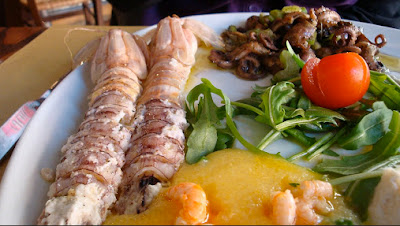
Some dishes served at Enoteca ai Artisti


tripadvisor.co.uk


Aitken
Wow, David. I'm impressed; pretty good Italian.

Newkirk
Thanks, Jen. I've been trying to add to my vocabulary for a few years now. And, I have to confess that Google translate is a huge help. Over the last few months I've just been trying to prepare "purpose-built" phrases and questions, and little explanations like this one about allergies. I don't want you to imagine for a minute that I've become fluent.

Aitken
Still ... it's great that you've learned what you have.

Wednesday, 15 May 2013


Act 2, Scene 3

The narrative began with Act 1, scene 1 on April 10, 2013.
To access all scenes, scroll to blog archive at the bottom of the page.

Picasso
Before you begin, I must assume that you are an artist, but I am not sure just what you do.

Aitken
I’m a sculptor, I suppose, although not quite in any traditional sense. I’m working with all kinds of materials lately… well, Pablo, I think you might be a bit more easily interested in what I do. You experimented with a lot of non-traditional media, and that’s kind of what I do. Although that’s nothing new anymore, of course.


Picasso
But don’t sell Diego short (nodding with a smile in Velazquez’ direction). He has been magnificent in seeing the work at the Biennale, working with such open-minded intelligence to appreciate it all.


Velazquez, smiling

Ah yes, well I certainly am making the effort; although I won’t claim that I have understood the point of every exhibit I’ve seen.


Aitken
Sure – of course. I’ll show you some images of my work later. But what I was saying is that I really don’t know much about art before 1850, so David’s idea of a train of thought, or artistic inspiration stretching back through generations of artists … well, it’s not really like that for me. Not yet anyway. My train really only goes as far back as you Pablo, and Rodin.

Newkirk
I guess what shocked me most was that, even though Jen attended a special arts secondary school, then graduated from one of our country’s most prestigious art colleges, and is now a bright light in the Master of Fine Arts program at another of the best schools – even with all this background, Jen was never exposed to much art history at all, at least not to any before the Impressionist movement, roughly speaking. Is that a fair assessment, Jen?

Aitken
Well, yeah, I guess, but we did study everything after Impressionism really thoroughly.
I do feel a real connection to the more recent past though...


Newkirk
I would think that any feeling of connection with the deeper past will be more difficult for Jen, and presumably for many young artists, to identify with. I've been struggling with this a bit. Diego, I hope you won't be offended, but I sometimes wonder whether there is a case to be made that, for artists today anything before say, 1850 for the sake of argument, really is irrelevant. Is it simply an esoteric exercise to reach further back into history? AND ... and ... since artists now often seem to feel that curating is an extension of their practice, are young curators also in the dark about the Renaissance, for example? And finally, does it matter?

Holland
Don't you think that this may have a lot to do with maturity? (Aitken blushes and starts to laugh). No, no Jen. I don't mean that you are immature; you certainly are not. I mean that with the simple passage of time, a person's interests can broaden. Maybe your time has been too full so far, to read about older periods of art history, to spark your interest.

Velazquez
Please excuse me for asking, Senorita Holland (Holland interjects, "Valerie, please Diego"). Valerie then, thank you. Are you too an artist?

Holland
Oh. No, well I'm not a visual artist. I trained in classical ballet, and I have done some work in the theatre, so I can relate to the difficult life that artists often endure. But these discussions are really interesting, don't you think?

Picasso (before Velazquez can respond)
A dancer! I should have known; I am helpless in the presence of a beautiful ballerina.

Holland (smiling)
Pablo! Get your hand off my knee, you little rascal. Olga was with Ballet Russes I believe, wasn't she? (Picasso nods with a lecherous grin). And I'm sure that you have some fascinating tales to tell about your friendships with Diaghilev, and Cocteau, and Stravinsky and a long list of others. I'd love to talk to you about the sets you designed for example, but really, stop flirting, Pablo!

Picasso
Ah, well. I am the old dog who has trouble with new tricks, but I'll do my best to learn.

Velazquez
Behave yourself, Pablo. Please ... I'm still waiting to hear whether I am irrelevant. (laughter and protests around the table. The wine has arrived; Newkirk offers a toast to the distinguished guests, and Velazquez reciprocates with thanks for bringing together so many wonderful artists. Pleasurable murmurs and comments on the wine. There is a lull in conversation as everyone turns to the menu.

Friday, 10 May 2013


Act 2, Scene 2

The narrative began with Act 1, scene 1 on April 10, 2013.
To access all scenes, scroll to blog archive at the bottom of the page.


Velazquez gestures toward the table where David Newkirk, Valerie Holland, and Jennifer Aitken are seated. As the two approach the table, Newkirk stands, extending a hand to greet them.


Newkirk
Pablo, Diego; wonderful to see you. We just arrived ourselves. Diego Velazquez, Pablo Picasso, I'd like you to meet Valerie Holland, and Jennifer Aitken. 


Valerie Holland

Holland, smiling warmly
You'll join us I hope. I've been looking forward to meeting you both.

Newkirk and Aitken agree, and insist that the two newcomers have dinner with them. Velazquez and Picasso readily accept the invitation and pull chairs for themselves to the table. Cutlery and napkins appear as if by magic, and the party of five settles in for dinner and conversation.


Newkirk
I hope you have been enjoying yourselves so far. I can't get over how many accepted my invitation. Venice is hard to resist at any time, but with the Biennale art also still here to see, how could you not want to join this group? Curiosity alone would have brought many, don't you think? Jennifer and I were just talking about this idea of artistic legacy, the notion of connecting various artistic influences through time – well, this "train" of linked achievements that, uh, inspired my creation of this event.

Picasso and Velazquez nod, and mutter an indication of their interest in the subject.

I was describing the connection between your work, Pablo and Diego's, and that of Paul Cezanne, for example, and that all of you were also somehow affected by Jacopo Tintoretto, regardless of whether there is any overt evidence of his work in yours. You both owe him a certain kind of debt, wouldn't you agree? ("Ah, Si "... emphatically from Velazquez, more agreement from Picasso)

My question for Jen was whether or not this idea of a creative or stylistic link with the past is one that still interests young artists of her generation. I think the answer is a qualified "yes," however the impulse seems to have been somewhat blunted, if I understand Jen correctly.

Ah, just a moment. (the pleasant-looking, middle-aged owner of the osteria has arrived at the table to ask about a choice of wine)
Buona sera. Tutto e bene?

Owner
Si, molto bene, grazie, e lei?

Newkirk
Molto bene, grazie. Vorremo due bottiglie di Sagrantino, per piacere. Il migliore che avete. Grazie. E anche dell'aqua minerale, con gas, per tutti.

Owner
Prego, signore. (leaves to get the wine and water)

Newkirk
I've ordered a wonderful Umbrian wine. They don't export much of it, at least not to Canada. And I asked him to bring the best he has (laughs). Since we are all together in this fantasy time-warp, we may as well also pretend that money is no problem and have the best wine, no?

Jen, explain to Pablo and Diego what you were telling me.