Tuesday, 20 August 2013


Act 4, Scene 1


The narrative began with Act 1, scene 1 on April 10, 2013.
To access all scenes, scroll to blog archive at the bottom of the page.


Without warning, the room fills with women – all of them adopting rather stern poses, hands on hips, or arms crossed – intently focussing their gazes on the one man present. Newkirk slowly gains control of himself, snaps shut his open mouth, nervously clears his throat.

Newkirk
Uh ... hello everyone ... ? I didn't expect ... I mean how did you ... ? Uh, welcome. He looks around the room, now beginning to recognize some of these women. Helen Frankenthaler leans against the wall at the rear of the crowd, quietly smoking a cigarette (in this non-smoking building!). Looking like a granite monument to Golda Meir and staring out the big window is Gertrude Stein. Berthe Morisot, Lee Krasner, Frida Kahlo, Georgia O'Keefe, Käthe Kollwitz, Lee Miller, Louise Bourgeois, Elaine de Kooning, Agnes Martin, Kara Walker, Colette Whiten, Shary Boyle, Joan Mitchell, Bridget Ryley, Faith Ringgold, Daphne Odjig, and several others Newkirk does not recognize stand shoulder to shoulder. Things looks a bit scary, from Newkirk's point of view. And something strange is happening to the faces. He must be imagining this, but it seems that each time he glances up, some of the faces have changed; other women appear and disappear; the group is not static. They fade in; they fade out. He becomes the cliché of a befuddled man, rubbing his eyes and shaking his head.

The woman who just a moment ago so abruptly interrupted his revery (no ... it couldn't have been her ...) seems to have disappeared.

Now making her way through the crowd toward where he sits (cowers?) in what has begun to feel like a child's swivel desk chair, is a petite young woman with extraordinary posture and physical presence. This, he realizes, is Marie van Goethem, the model for Degas' bronze, La Petite Danseuse de Quatorze Ans.

Marie, in a voice as silky as olive oil and with a mesmerizing French accent:
Bonsoir, M. Newkirk. You luke a beet pale. I 'ope you are feeling okay? 

Newkirk
Uh ...

Marie
We have come here to suggest that perhaps it is time to leave alone this legacy of white men that you have been writing about, non? Do you really want to continue to make these small lessons of history, these lessons about white men who think that it is important to pay homage to other white men?

Newkirk (speaking rather too rapidly and nervously glancing from face to face)
Uh, well ... I did have a few more artists I wanted to mention. You see my plan was to trace an artistic legacy right up to the present. AND ... and, I was going to get to some wonderful women artists, really I was, and (with a note of panic) some First Nations artists, and some African American artists, and ... he sounds pitiful, and he knows it.

General murmuring and shuffling of feet in the room.

Marie, with terrifying sweetness
Well ... okay, how about you do this: take a moment to make the rest of your list. Go on. We wait while you do this. But you will dispense with all the blah, blah, blah lessons in history, non? (She glances around at the changing group of other women, many of whom grudgingly nod their assent). You make your list; you make this list with, how do you say, links, oui? and then everybody can look at these links and be happy to know everything! (She smiles broadly now, but Newkirk notices that, as hers is still the only smile in the room, it affords little comfort.) And then maybe ... maybe one day soon you will again talk with some of these people on your list, as you did at the start, non? And then you can tell us again some interesting stories about them if you like. This sounds okay for you?

Newkirk
Uh ... well, uh ...

Marie
Bon! (She claps her hands together in apparent delight). And then we will have a nice talk, okay? Maybe first we talk about me! (she lights up) and Monsieur Degas.

Newkirk squirms, and attempts his own smile. He fails.

Monday, 19 August 2013


Intermission, part 10


The narrative began with Act 1, scene 1 on April 10, 2013.
To access all scenes, scroll to blog archive at the bottom of the page.

This intermission attempts to track the connected artistic 'lineage' of some influential painters, from the early 15th century to the present. To follow this thread and to see all images mentioned, 
go back to part 1 of this intermission.


Below is a list of artists I have mentioned to date in this blog (and roughly arranged in chronological order) as belonging together in a long line of teacher-to-student influence, either in face-to-face exchanges between the artists, or more indirectly when one artist learned through the work of another he strongly admired:

Tiziano Vecelli (Titian)
Edouard Manet


The glaring omission of women artists might, up to this point at least, be excused due to the unfortunate historical male chauvinism of western societies. However, since the late 19th century, women are increasingly successful in staking out artistic turf, which after all is the turf of authentic expression, rather than of the sex of the artist. The subject of artistic endeavour might be sex or politics or psychology – an artist will explore the issues that interest him or her – but great art is about the artist; the subject of art is secondary.

Newkirk sits staring at his computer screen, at the list he has just created and the pathetic apologia he has composed. A door slams. Breathless and muttering angrily, a woman charges uninvited into the room.

Loretta (shouting)
WAIT A MINUTE, WAIT A MINUTE!


Newkirk (clearly bewildered)
Cher? Whuh ... ?

Loretta (really steamed)
French? You wanna get fancy, talk Italian. Intermission's over, buster.


Friday, 16 August 2013


Intermission, part 9


The narrative began with Act 1, scene 1 on April 10, 2013.
To access all scenes, scroll to blog archive at the bottom of the page.

This intermission attempts to track the connected artistic 'lineage' of some influential painters, from the early 15th century to the present. To follow this thread and to see all images mentioned, 
go back to part 1 of this intermission.


Jean-Auguste-Dominique Ingres (1780 – 1867) has been acknowledged by some (both Matisse and Barnett Newman among them) as having an important role in the birth of abstract painting. Ingres sometimes took liberties with the natural appearance of his subjects, for instance exaggerating or moving into view bits of anatomy that otherwise would have remained hidden.

Jean Auguste Dominique Ingres, La Grande Odalisque, 1814


This kind of confident experimentation – an ancestor of Picasso's creative approach to anatomy – emboldened Edgar Degas, a particular admirer of Ingres' work, and Edouard Manet. 

Degas' The Tub, of 1886, with some objects cut off snap-shot style, by the edges of the painting, demonstrates the artist's interest in photography as well as his fascination with the idea of playing with spatial perceptions. The pitchers on the right are shown in full profile, whereas in a "natural" view, we would see them from slightly above, as we see the shelf and the female model. (The question of misogyny will be left for debate in a later posting.)

Edgar Degas, The Tub, 1886

Manet's Olympia is often seen as a re-interpretation, if not an homage to Ingres' earlier Odalisque.

Edouard Manet, Olympia, 1863

But it is this revolutionary painting that particularly stunned the art-going public in that same year, 1863.

Edouard Manet, Le Déjeuner sur l'herbe (Luncheon on the Grass), 1863

Manet holds a pre-eminent position among artists as a founding father of modern art. However, before continuing, I'd like to list the names of artists we have discussed to this point, as well as the others I consider to be part of this lineage, but who have not yet been mentioned here.

Wednesday, 14 August 2013


Intermission, part 8


The narrative began with Act 1, scene 1 on April 10, 2013.
To access all scenes, scroll to blog archive at the bottom of the page.

This intermission attempts to track the connected artistic 'lineage' of some influential painters, from the early 15th century to the present. To follow this thread and to see all images mentioned, 
go back to part 1 of this intermission.


And then came photography.

Photography has been a game changer for the art of painting. The historical depth of photographic experimentation is impressive. Pinhole cameras have been in use since the time of Aristotle (384 BC – 322 BC). Canaletto was able to produce highly detailed scenes of Venice, for example, with the help of a camera obscura in the early18th century; and the first successfully etched permanent photographic image was made in 1822 by Nicéphore Niépce. Delacroix was a pioneer in the use of photographs in his studio practice. Artists since the 19th century have been able to use photographs and to manipulate them to freeze light and shade, to magnify detail, to verify or interpret colour (after the arrival of colour printing), and to freeze the pose of a model, for example. On the other hand, photography encouraged some artists to explore the perception of space in new ways, to re-interpret the appearance of objects, and finally to examine those formal aspects of painting that are unrelated to the visible properties of any object in the natural world.

The Neo-classical style of David and Ingres, the Romantic art of Delacroix, and the new art of photography all played roles in the evolution of Impressionism, and perhaps in all painting since.

Below is an excerpt from the web site of the Musée National Eugène Delacroix 
6 rue de Furstenberg 
75 006 Paris

Baudelaire, for whom Delacroix was the modern artist par excellence, would sit on a bench in the Place de Furstenberg on the lookout for the artist who he would then follow without daring to approach directly. From the window of a neighboring building, Monet and Bazille would try to make out his shadow as he went about his business in his studio. Manet would ask for permission to copy the Barque of Dante (Lyon Musée des Beaux-Arts; New-York, Metropolitan Museum) in the Louvre. Fantin-Latour painted a Homage to Delacroix (Paris, Musée d’Orsay). Thus grew up a small set of admirers around the figure of Delacroix.
This tutelary image was to have a lasting effect on artists such as Cézanne, Degas, and Van Gogh, all three of whom copied his compositions. Cézanne worked fervently on an Apotheosis of Delacroix that he would never complete. He even delighted in singing the praises of the red of the oriental slippers in Women of Algiers (Paris, Musée du Louvre), comparing its savor to that of a glass of wine in the throat and readily asserting to anyone who cared to listen that "we all paint through him!" Degas, a collector of past works, brought together almost two hundred and fifty of the master’s paintings and drawings.
The Impressionists were also highly indebted to him. With his disjointed brushwork and palette of varied hues, Delacroix provided a foretaste of solutions that the open-air painters would adopt to convey the effects of light. This is apparent in some of his sky studies in watercolors or pastels, and in a small painting, the Sea at Dieppe (Paris, Musée du Louvre). Seurat and Signac studied Delacroix’s works and writings at length. Like him, they set their art between "mathematics and music," and in 1899 Signac even traced a direct line of descent in a treatise entitled From Eugène Delacroix to Neo-Impressionism. Moreover, Signac, like Maurice Denis, another great admirer of Delacroix, was one of the founding members of the Société des Amis d’ Eugène Delacroix, established in 1935 to save the studio on Place Furstenberg from being destroyed.
Claude Monet, Bathing at La Grenouillere, 1869

Monday, 12 August 2013


Intermission, part 7


The narrative began with Act 1, scene 1 on April 10, 2013.
To access all scenes, scroll to blog archive at the bottom of the page.

This intermission attempts to track the connected artistic 'lineage' of some influential painters, from the early 15th century to the present. To follow this thread and to see all images mentioned, 
go back to part 1 of this intermission.


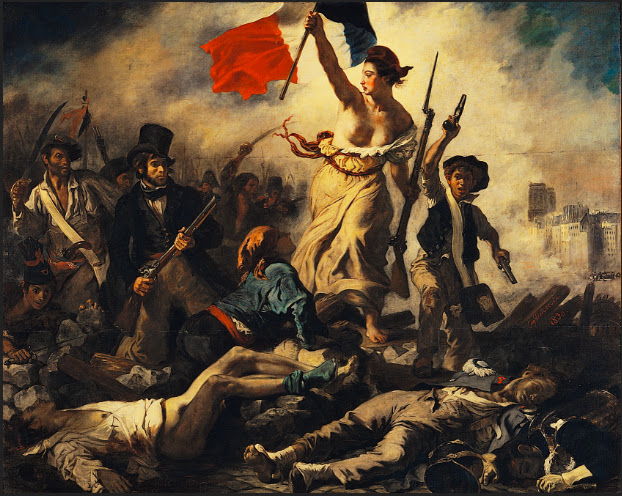
Artists of the 18th and 19th centuries were deeply affected by the times in which they lived. The Enlightenment, revolutionary zeal, war, famine, oppression, the Industrial Revolution and the subsequent "shrinking" of the world (both people and ideas traveled faster than in previous periods), the bohemian life of artists largely set adrift by the old system of patronage by Church and State – all were conditions making art ripe for change. Free of the necessity of painting flattering portraits of the wealthy aristocracy, of making erotically amusing paintings – thinly-veiled as illustrations of biblical or mythological themes – for the same clientele (see, for example, Lucas Cranach the Elder), and altarpieces for the Church that had for centuries been financially aligned with the same aristocratic class, young politically astute artists turned inward to explore their own artistic ideas. The great Romantic painters took on politics as well as motifs related to more exotic times and places.

Eugène Delacroix, Liberty Leading the People, 1830

Théodore Géricault, The Raft of the Medusa, 1818-19
An interesting note about Géricault, considering our intergenerational interest in painters like Titian and Velazquez: "Géricault soon left the classroom, choosing to study at the Louvre instead, where (from 1810 to 1815) he copied from paintings by Peter Paul Rubens, Titian, Diego Velázquez, and Rembrandt. It was during this period at the Louvre, that he found a vitality which he preferred to the prevailing school of Neoclassicism." (http://deskarati.com/2011/12/16/theodore-gericault/).

Stepping back for a moment to review the artistic legacy we have traced to this point, at first glance it would seem difficult to connect the paintings of Barthélémy d'Eyck (1444-1469, blog post archive, July 20, 2013) with those of Géricault and Delacroix. However, if you take the time to retrace the influence trail we have explored, I think you'll find a fairly direct line of descent. As I previously have pointed out, that line might well be followed in other directions as well, where the branches of our "family" tree have diverged.


Saturday, 10 August 2013


Intermission, part 6


The narrative began with Act 1, scene 1 on April 10, 2013.
To access all scenes, scroll to blog archive at the bottom of the page.

This intermission attempts to track the connected artistic 'lineage' of some influential painters, from the early 15th century to the present. To follow this thread and to see all images mentioned, 
go back to part 1 of this intermission.


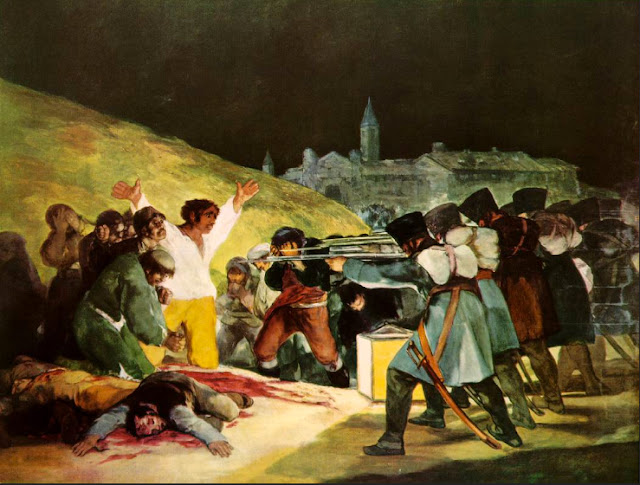
The crushing realities of the Napoleonic wars also profoundly affected Goya. Although one would not consider his painting The Third of May romantic in any way, it is almost electrically charged with emotion, a key ingredient in the art of the Romantic period. Goya composes a tableau that sets in opposition the conflicting human responses to the chaotic conditions of the time – the desire for a logical solution to all problems (the orderly efficiency of the firing squad), and the real emotional response to oppression and tragedy (the victims).

Francisco Goya, The Third of May 1808, 1814


The testy relationship between these two human characteristics (logic and emotion) has provided fertile ground for exploration by many artists (including the author) through to the present day. And this interest is not limited to the traditional arts. Some of the characters in the cultish sic-fi TV show Star Trek, for example were developed in order to explore this precise dynamic. Think of Spock and McCoy, or in The Second Generation series, Data and Giordi. It's a theme I think you'll often find in theatre, TV, movies dance and opera.

In his later years, Goya's work entered the realm of psychology, something we tend to think of as a 20th century preoccupation.


Francisco de Goya, Bobalicón, 1816-1823


Wednesday, 7 August 2013


Intermission, part 5


The narrative began with Act 1, scene 1 on April 10, 2013.
To access all scenes, scroll to blog archive at the bottom of the page.

This intermission attempts to track the connected artistic 'lineage' of some influential painters, from the early 15th century to the present. To follow this thread and to see all images mentioned, 
go back to part 1 of this intermission.


The 18th century and the Enlightenment saw a burgeoning interest in the classical periods of ancient Rome and Greece. Architects often studied the ruins in Rome, for example (as Brunelleschi had done in the early Quattrocento), and created new designs to reflect a widespread admiration for the ancients. Robert Adam and Piranesi (known for his etchings - perfected under the influence of Venetian artists) were two such architects.

The affection for things classical became evident in painting in a couple of ways that historians once tried to detach from each other in order to simplify our human predilection for assigning things to categories. Neo-classical artists such as Jacques Louis David explored classical themes in their work as an illustration of the logic of the Enlightenment. David in particular was highly influential as a court painter toward the end of the French Ancien Régime. He handily made the transition to revolutionary, and finally back to monarchist as Napoleon's artist of choice.

Like the paintings of Caravaggio, David's work is highly polished, although it is also less genuinely human and natural, and more monumental in its intent.
Jacques-Louis David: The Oath of the Horatii, 1784

Neo-classical painting reflected the orderly and logical nature of classical art and architecture. At the same time, however, the revolutionary spirit of the time was aligned with the republican period of Rome. There was logic in this affinity, but the transition from monarchy to republic and back (several times in the case of France) was anything but orderly. It was a messy and very emotional period in the history of Europe. As well, looking so far into the past for models of government, behaviour and art was a quite romantic notion. Greener hills in the past, the glory that was Rome, simpler times, the nearly universal use of Latin and Greek - all of these things fascinated people who were seeking change, and escape from the realities of poverty, oppression and war. Ancient Rome was an exotic idea - distant in time, and conjuring the romance of distant places in that vast and long dead empire.

Naturally, artists were among those who espoused the romance of far-away times and places. And by the time of the French revolution, the traditional patrons of the arts, church and state, had largely abandoned the best avante garde artists. Left to their own devices, painters broke free of the restraints that had been imposed by wealthy patrons and by the church. They began to paint subjects of their own choosing, since no one was paying them to do otherwise. Here are the origins of the stereotypical image of the bohemian artist, starving in an attic in Paris. During much of the 19th century, for many artists (like Van Gogh, for example) the stereotype fit like a glove.

So, while in the work of Neo-classical painters like David, order and logic were paramount, at the same time young Romantic artists were exploring the messier side of being human.

Goya had visited England where he was deeply affected by the work of the English Romantics, Turner and Constable.