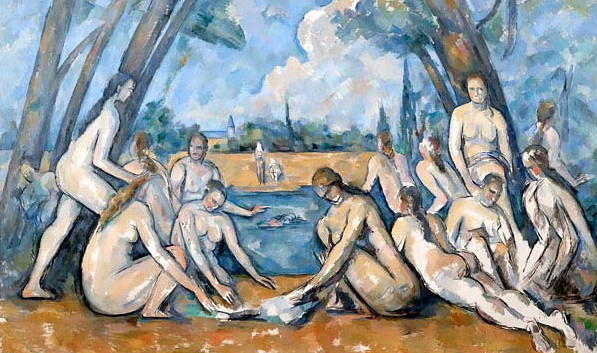
Monday, 29 April 2013


Act 1, Scene 10

The narrative began with Act 1, scene 1 on April 10, 2013.
To access all scenes, scroll to blog archive at the bottom of the page.


Titian
CAZZO! CazzINO! You little prick! I should have slit your throat when you first showed up at the studio. (arms flailing, curses, grunts and groans). Get out of the way Giorgio, I'm going to cut him a new asshole!

Giorgione (yelling)
Tiz! Tiz! Stop this – calm down. What the hell is wrong with you? (Tintoretto falls, and this seems to satisfy Tiziano, for the moment at least, as he backs away to catch his breath). Are you alright, Jacopo? No Tiz, stop your kicking. Get up off the pavement Jacopo. Everyone just calm down for a moment. What happened? Why are you two at it again?

Giorgione Barbarelli da Castelfranco

Tintoretto (breathing heavily, accepts a hand from Giorgione, dusts himself off and glares at Titian, nods in his direction)
We met for a glass of wine at Harry's, and of course dick-face here kept refilling his glass until he was completely pissed. He got louder with every swig, and finally up came all the old complaints.

Titian (looking a bit sheepish now, and perhaps a little green)
Yeah, well. You screwed me out of that job at San Rocco, you prick. Stupido! CAZZO!

Tiziano Vecellio


Tintoretto
You know damned well that's not what happened. Your proposal was on the table for four years – four years! – and nothing came of it. Sure, I out-foxed Veronese and the others, but that's no skin off your nose. Giorgio – tell him.
Tintoretto (Jacopo Comin/Robusti)


Giorgione 
Tiz, you're drunk. Oh jeez, don't puke on my shoes. Come on, let's find a place to sit down. Jacopo is right, Tiz. What's gotten into you? And put that damned knife away before the police or the Carabinieri are on us. Here, come around the corner. We'll go to the canal ... you've always enjoyed the walking along Schiavoni. The gondole actually are quite beautiful in this light, but we're going east, and nowhere near Harry's this time. Come along, the air freshens nicely at this time of day – you'll feel better. Jacopo, give us a hand. (... and they stroll away toward the canal, Titian's arms flung over the shoulders of the friends on either side, completing the classic image of pals indulging a drunken comrade)


Tuesday, 23 April 2013


Act 1, Scene 9

The narrative began with Act 1, scene 1 on April 10, 2013.
To access all scenes, scroll to blog archive at the bottom of the page.


Shuebrook
And would you say that this particular concern also explains your distortion of shapes like bowls and vases, and even of figures and faces? Where did you find the courage to break so decisively from the observable appearance of things?

Cezanne
Take a look one day at El Greco's Opening of the Fifth Seal, and you may want to reconsider the idea that it was I who had this courage. Oh, I know that what I did was quite different, but one mustn't claim more than his due. I find it so interesting that a painter such as yourself, whose work is so nearly divorced from the things we actually see – except perhaps as a point of departure – that you speak of my efforts as courageous, even today. And your work, from my point of view, is a very compelling balancing act: power and peace, order and disorder; it can appear to be brutal and tender at the same time. I like it very much. Never in my wildest dreams could I have imagined the multitude of interpretive approaches that artists have invented, once it became acceptable to diverge from what we had always thought of as the ultimate truth, the ascendancy of Renaissance window perspective. Courageous? Yes, perhaps. Certainly the critics were not kind to me in general. I think perhaps that these people who write about art have learned something since the early days, no?

Shuebrook
Well, you may be right about some. It's true that most of those who write about art are less likely to denigrate something simply because it seems new, or doesn't fit easily into any identifiable tradition. A few are exceptionally good – those who truly know the difference between a great work of art and a near miss. I enjoy reading Peter Schjeldahl in the New Yorker Magazine, and some Canadian friends write very well.


Cezanne
Wait! Look over there, directly across the piazza. What is that commotion? Do you hear the shouting? Something is happening at the foot of the Campanile.

http://www.bigfoto.com/europe/italy/venice/

... standing now, and motioning for Shuebrook to follow him toward the commotion.
Three men. Two seem intent on killing each other while the third is trying to keep them apart. I think that is Titian brandishing a knife, isn't it?

Shuebrook
You're right! Oh dear, this doesn't look good. Who are the others? Oh, I recognize Tintoretto, but ...

Cezanne, almost gleefully
The referee is Giorgione! Eternally young and strong – what a terrible tragedy to have lost him so early in life. Come, I love a good argument – all the mores if it comes to blows! Look – I think Titian is bleeding from the nose.

Shuebrook and Cezanne detach themselves from the crowd that has gathered, and continue their conversation as they enter the narrow street on the north side of the basilica and disappear from view.


Sunday, 21 April 2013


Act 1, Scene 8

The narrative began with Act 1, scene 1 on April 10, 2013.
To access all scenes, scroll to blog archive at the bottom of the page.


Cezanne
Well, for one thing, you have to consider the events of the time. Photography had become fairly commonplace, and photographers had begun their own experiments. They were certainly playing with new ideas of perception. Then there was electric lighting. Can you imagine how the brilliance of electric street lamps compared with the gas lamps we had grown up with? Suddenly there were harsh shadows and defined edges everywhere. You could not help looking at a carriage, for example, differently. Motion pictures, and stereopticons ... more and more change in the ways we saw the world. Do you remember playing with your grandmother's stereopticon? These little devices were fascinating ... still are, I think.

source: http://ephemeralnewyork.wordpress.com/category/union-square/

So, one didn't have to look very hard to find "new ways of seeing reality." To me, it seemed at first that these were all 'rule-breaking' when it came to perceiving the physical world around us. But then I thought, why not? We may not have been accustomed to these things, but they were here to stay. So, I began to wonder, if this, then why not that? If we can see a three-dimensional representation through the stereopticon, a revolutionary change in the way we saw things, then who's to say that objects in the world might not be analyzed and observed in still other ways?

And of course we cannot ignore the work of Edouard Manet ... a true genius. After Velazquez, we knew that we could take the viewer just slightly beyond the picture plane, into shallow space, and then beyond that into deeper levels within an illusion of three dimensions; and that we could then bounce that same viewer like a tennis ball off the deepest walls in the painting’s space and back to smash through the picture plane again and into the space in which he or she actually stands. And after Manet, we knew that we could also affirm the integrity of flatness. I gradually became more and more fascinated with pondering these various "planes" rather than concentrating on pictorial effects – atmosphere and so on, things that seemed more important to some of my Impressionist friends. But Monet's brush! Marvellous the shapes he could create in his brush strokes. In my own work, each brush stroke became a plane to manipulate. I suppose some would argue that my obsession with this sort of thing relegated other concerns, like colour, to lesser positions of importance; and while one cannot dismiss the power of colour to advance and recede, I do see evidence in my work for that point of view.

Act 1, Scene 7

The narrative began with Act 1, scene 1 on April 10, 2013.
To access all scenes, scroll to blog archive at the bottom of the page.


Back in the piazza, conversations continue. Those who have not wandered off to see other parts of Venice have formed several small groups. A few pigeons flutter by. The crowd of tourists is thinning as people find places to rest and relax at the end of an afternoon of walking and taking photographs. Cezanne has joined Ron Shuebrook in friendly conversation.


Ron Shuebrook
Cezanne
I must say that I find this city enchanting. I have not traveled a great deal, but I feel comfortable here. I suppose it has to do with the water, and the quiet. The world has slowed its pace here. I do wonder, however, about some of the invited guests. It's hard to imagine that some of them really belong here among such distinguished artists. Look at that fellow over there, for example, the one in the shadows. He appears to be making odd noises completely oblivious to the tall chap who is sitting with him.

Shuebrook
Oh, over there? Yes, that is a colleague of mine – the tall fellow, I mean – Martin Pearce, very talented, and smart as a whip. His is a highly informed intellect. The other man is an American, a rather odd one I'll grant you, Henry Darger. He is what we call today an outsider artist. You might have used the term naive, or perhaps self-taught. I suppose he fits with artists like Henri Rousseau. We can walk over to meet them, if you like.

Cezanne
Thank you, but not just now I think. What is he doing?

Shuebrook
Some believe that he may suffer from Tourette syndrome. I'm not sure you are familiar with the term. Sufferers sometimes seem not to have any conventional filters for their speech, and their behaviour. They can shout out very inappropriate comments at the oddest moments. Apparently his problem has not completely been resolved, even with treatments available today.

But, if you don't mind, I'd like to hear your thoughts about your own work. Venice is a gorgeous setting for a gathering like this one, although ideally I would have met you for a chat at a cafe´ in Aix.
But that aside, I'm so happy to have the chance to tell you of my own admiration for your work; you have been a crucial influence for me. Of course you know how widely artists around the world today concur with that sentiment. I wonder, have you seen Roger Fry's discussion of your work – it's a beautifully written and I think insightful little book.

Cezanne
No, I haven't seen it, but someone else mentioned it to me this morning. I wasn't around for its publication ... at least not until now.

Shuebrook
I'd like to read a short passage, if you don't mind. (Cezanne nods, and flicks his fingers toward the book, a gesture that says "go ahead." Shuebrook adjusts his glasses and reads.) 

"... the actual objects presented to the artist's vision are first deprived of all those specific characters by which we ordinarily apprehend their concrete existence – they are reduced to pure elements of space and volume ..." then a little about your intelligent organization of these objects, and then "These abstractions are then brought back into the concrete world of real things, not by giving them back their specific peculiarities, but by expressing them in an incessantly varying and shifting texture."

Cezanne
That's quite nice.

Shuebrook
Does it sound like a fairly accurate description of what you really do?

Cezanne
Yes, I think it's close. As you know, each of us has a very specific feeling about the words used to describe our work, but this doesn't offend me.

Shuebrook
What I would like to ask you, is how you found the courage to embark on this process of restructuring the visible world. Or perhaps you felt somehow compelled to do so?

Still Life with Apples, Paul Cezanne, 1894

Cezanne
I see. Yes, this is an interesting question, especially considering the art of the generation that followed my own – these younger artists fractured the old rules about reality in far more radical ways than I did.

Shuebrook
Well, with respect, I think many would argue that the paradigm shift you created was the truly radical moment for Modernism, and that many of the artists who followed you did just that – they followed. Not to minimize their achievement, but I simply want to point out how revered your work continues to be. It's the view of most students of the period that yours was the watershed moment.

Cezanne
That's very kind.

Shuebrook
But why? Why did you begin to see in a different way, and to translate that vision into art?

Wednesday, 17 April 2013


Act 1, Scene 6

The narrative began with Act 1, scene 1 on April 10, 2013.
To access all scenes, scroll to blog archive at the bottom of the page.


Agnes Martin
Most of us here today seem to be painters; and so far I have not seen many young artists, although maybe they simply haven’t arrived yet. (turning to Whiten) Colette, you aren’t a painter – at least that isn’t an area of focus for you. And you teach at an art college or university in Toronto, is that right?

Whiten
Well, no actually. I've retired from teaching, but I was at the Ontario College of Art and Design. It's been a degree-granting university for a number of years now, thanks largely to Ron Shuebrook, by the way. The school's moniker since that began is OCAD University.

Colette Whiten
Martin
Did you see any evidence among your students, of an interest in this Juicetrain idea? Not this manifestation in particular of course, but in the idea of a legacy, a lineage, some linking between generations of artists? I made a choice to drop out of sight, get away from "the scene" in New York; but that's quite a different proposition. I don't think I could ever claim not to have been influenced by anyone. What do kids who are starting out think, I wonder.

Whiten
Well, you have to remember how young the students are. When they enter an art program after high school they can be as young as seventeen or eighteen, and with some exceptions, most have not had much grounding in the history of art – often they’re largely unaware of the interests and achievements of other artists, from any period, including their own. People like to point fingers at the education system, and at teachers, but considering the issues that high schools have to deal with, I think that it’s a bit too easy to think that we can blithely assign blame for what we think is missing from a kid’s education. And they don’t stay eighteen. That's just where they begin to sort themselves out. There is a huge dropout rate each year. I think a lot of kids believe that the can be artists simply because they like to draw and because art was their strongest subject in high school. At the end of four years, a few are left, and of those, fewer still really know how to engage with the art world, or what it will take for them to succeed. And from the many, a few amazingly talented artists emerge. It’s a winnowing process, as you know. It staggers the mind when you think of the number of students enrolled in fine arts courses in Canada alone … and then there’s the rest of the world.  Only a few stick with this career, and fewer still achieve anything substantial. It’s a tough life.

Brice Marden


Marden
It’s your Shary Boyle we should be asking about this. I don’t know Shary personally, but just to look at her work here at the Biennale, you have to think that she’s a subscriber to this idea of links with the past. How far do you have to go to find a Della Robbia porcelain? She’s doing something quite different, obviously, but isn’t that exactly what we’ve been talking about … exciting new achievement connected with the past?


Sunday, 14 April 2013


Act 1, Scene 5

The narrative began with Act 1, scene 1 on April 10, 2013.
To access all scenes, scroll to blog archive at the bottom of the page.


We hear the clatter of demitasses and lattes as waiters place them on the small tables. The delightful aromas of coffee and fresh cornetti (con crema and con cioccolato) float over the piazza. Conversations relax into a sleepy buzz, and for now everyone becomes part of the lazy ritual of afternoon coffee time. The light warms and softens as shadows slowly lengthen. Here and there people bid each other "buona sera," and drift off in various directions, singly, in couples and in small groups. 

Inside Caffé Florian , Barnett Newman and Agnes Martin have joined Velazquez, De Kooning, Van Gogh, and Brice Marden. 

Newman
I'm enjoying this; it's a very interesting group of artists. I was just speaking to a young Canadian painter outside, John Kissick. He's having some trouble keeping the spark of our enterprise alive within himself, I think. You know, the whole project of abstraction. And I suppose I can relate to his feelings of doubt; after all, our trajectory as a group – if you can accept for a moment that we share this journey (I mean abstract painters), despite the differences in our approaches – the trajectory is rather steep. We are a fairly young phenomenon, not even as enduring yet as the periods we call early to high Renaissance. We are perhaps 100 years old, and a bit. And like the art of the early Renaissance – small altarpieces, and then some frescoes by Giotto and Massacio, for example – the pioneers of abstraction often produced quite modest works. And why not? Who would have had the confidence, in the early days to make a painting 20' long? Nobody. But what guts they had to step out on that ledge!

My own feeling is that, in order to truly feel the achievement of any certain period of innovation, you have to 'become' one of those artists. You have to know, in your heart, the authentic, genuine self of the artist who felt he or she simply had to do something in a new way – in a way that felt right, that felt compelling and authentic to that artist. That, I think, is the beauty of a gathering like this. Just look around. These people are just like us. They couldn't help themselves. They were compelled to do what they did. And I, for one, feel privileged to sit among people whose innermost expression of their humanity has found its way into a physical realm where we can all try to connect with that humanity.

Marden, removing his wide-brimmed straw hat, and placing on an empty chair with Van Gogh's ...
I agree, Barny. Art is a humanist endeavour. You have to get inside the "why" of an artist to really understand the work. You and I are small links in this connected legacy – Newkirk is calling it The Juicetrain – we come out of the Renaissance, no question. We're all connected, back as far as that and farther I think. What was it Andy said? "Everybody is influenced by everybody."And look at all these people we don't know yet. This is like being a kid in a candy shop. These artists are all doing such interesting things. Ideas we can pick up and turn over in our hands while we chat. What a blast.

Sips his espresso, and continues. The others defer patiently for now ...

And look at all these people we don't know yet. This is like being a kid in a candy shop. These artists are all doing such interesting things. Ideas we can pick up and turn over in our hands while we chat.

But this testing of faith is common to all great achievements in the arts. How can we feel the achievement, the fire of Michelangelo? There's only one way – you have to be him for a moment. You have to imagine your hands on that impossible block of marble that became the David. You have to experience his compulsion. Otherwise, you're just going to be looking at a hunk of rock that some guy chipped away at. And I think the closer you are to a particular ethos, the more compelling it is to question it. It's like self doubt, and it's a healthy thing, don't you think? Sounds to me like this Kissick is turning it all over in his hands. It'll be interesting to see what comes out of his questions.

Thursday, 11 April 2013

Act 1, Scene 4

The narrative began with Act 1, scene 1 on April 10, 2013.
To access all scenes, scroll to blog archive at the bottom of the page.


David Newkirk, climbing carefully up to stand on one of the many chairs.

Hello everyone and welcome. I am David Newkirk, an artist from Toronto, Canada. No doubt you would like some things explained. You have noticed, for example, that we all understand the many languages represented here ... very convenient, I think. And looking around, you will see that we are nearly all artists. Many of you will find it a bit disorienting to be in Venice in September, 2013. However, I think you'll enjoy yourselves as you get used to the idea. How could you not, when you see who else is here? The simple explanation for your presence is that I wanted to say "thank you." Thank you for the art to which you have given yourselves so completely. Thank you for the privilege of being able to stand close enough to the things you have made to 'feel' your hands as they touched canvas. Thank you for allowing me to feel some of your yearning, your searching, and your expression of so many authentic ideas and emotions. These words sound sentimental and hokey, even trite as I speak them. Perhaps feelings of nostalgia and gratitude are simply a function of my age. Nevertheless, I would be someone else entirely without having experienced your art. 

This gathering is selfish as well, in a way. I wanted to bring together all of you who have informed my life and work, to speak with you, to share your company for a time. On your invitation, this event was called The Juicetrain Dialogues. If you are interested in a more detailed explanation of that title, you'll find a description on my web site. (Van Gogh is heard to mutter "What the hell is a web site?" Laughter and applause ripple through the crowd). Briefly though, you are the links in the train, the Juicetrain – a lineage, a legacy if you like – and this train's cargo is its vitality and it's interconnected indebtedness ... its juice. I am at work on a series of paintings that will be shown together as The Juicetrain Dialogues, next year. The paintings, while they are neither portraits nor interpretations of your work, are expressions of my gratitude to you all. My hope is that, when they are assembled together, the paintings will continue the conversations we have begun here today, and that others will join in our discussions. I see the project as a variation on the early Renaissance convention of the sacra conversazione, this time however, without any religious overtones. Perhaps this will all become clearer as we talk. But it's not my own work I want to discuss with you, it's yours, and your experiences, your ideas. This event is what my imagination suggests you might say to each other, given the chance. Of course just what you might say may have nothing at all to do with art. We'll see. 

Now that you are here, I hope you'll agree that spending time together will be both fun and interesting. The words you speak in these pages will in fact be my own, as this is my own particular, entirely fictional fantasy; or they will be the actual words of some of you who have agreed to be co-authors in this endeavour. I apologize for creating any dialogue that may not feel quite right to you. I hope that, when possible, you will join the conversation and represent yourselves accurately. If you wish to become a new participant, please notify me in advance so that I can adjust the narrative here to give your character an entrance. By that I mean that I would write something like "so-and-so left the train station and encountered someone at the vaporetto platform." Then you can go ahead and create some dialogue, and a scene of your own devising.

None of us knows with certainty just where this conversation may take us, but I hope we can all enjoy finding out. I'll try to participate in your discussions when I can, and will eavesdrop on others. And I have also decided that, as time itself is a malleable thing for my purposes, I won't be limiting my own editing to a strictly linear model. To add richness to the anecdotes and descriptions in this story, from time to time, I plan to go back to earlier scenes to insert new details and ideas. 

I am overwhelmed at being in your company, and I suspect that others of you will feel the same. Time now for coffee. Thank you again for coming. Enjoy your stay. Oh ... and my special thanks to Diego Velázquez, who has been of enormous help in getting you all here. (applause) Enjoy this beautiful city; enjoy the company; enjoy the conversation.

Newkirk steps down, walks into the cafe´ with Velázquez and others. Canadians Jack Chambers, Ron Shuebrook, John Kissick and Colette Whiten sit at a couple of tables, enjoying the sun and all the activity in the busy piazza. Barnett Newman and Agnes Martin turn their chairs to join the Canadians.

Barnett Newman
http://jameswoodward.wordpress.com/2012/02/01/barnett-newman/

Newman (smiling warmly, speaks to Kissick) John, (shakes hands) your work is quite exciting. I am an admirer, but tsk, tsk! a "lethal slide into outright abstract atheism?" What do you have to say for yourself, my friend? Do you feel any differently now, being here with us among De Kooning, Marden, Picasso, Velazquez and all the others?

John Kissick


Kissick
"Well.... faith is hard to come by these days, and I'm not entirely sure if I am dreaming right now or cast in some strange postmodern play. In any event, if I am indeed sitting next to you, Barny, then abstraction is clearly not Dead ... and I am a believer again!!" [1]


[1] Contributed by John Kissick


A waiter approaches the group and takes orders for coffee. Barnett Newman and Agnes Martin excuse themselves to join others inside the cafe´. John and Joice Hall pull their chairs over to join fellow Canadian artists Chambers, Kissick, Shuebrook and Whiten. John Hall makes introductions and sits down beside Jack Chambers.